Passenger Waiting Time is defined as the actual time a prospective passenger waits after registering a hall call (or entering the waiting queue if a call has already been registered) until the responding elevator doors begin to open. If the elevator doors are already open when the passenger arrives, their waiting time is recorded as zero.
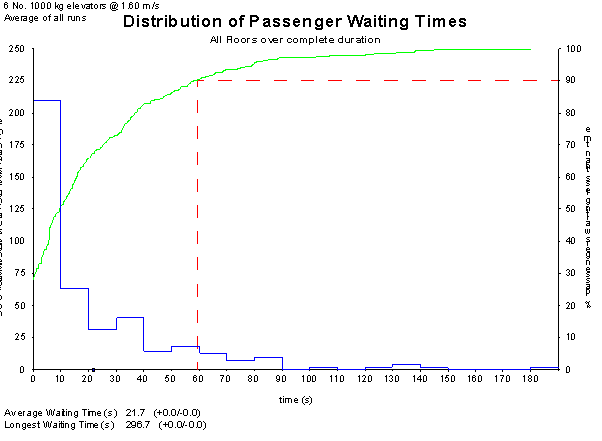
Elevate presents a graph of passenger waiting time distribution in two ways:
- Right-hand Y axis (Percentage): Shows the cumulative percentage of passengers whose waiting times are less than or equal to the values on the X axis. A dotted line highlights the 90th percentile.
- Left-hand Y axis (Passenger Count): Shows how many passengers experienced waiting times within each time range (i.e., histogram-style distribution).
Elevate also reports:
- Average Waiting Time
- Longest Waiting Time
- Range (if multiple simulations): If more than one simulation is run per configuration, Elevate shows an average result and a range. For example: 30.0 (+5.1 / -1.5).
Was this article helpful?
That’s Great!
Thank you for your feedback
Sorry! We couldn't be helpful
Thank you for your feedback
Feedback sent
We appreciate your effort and will try to fix the article